
How it works
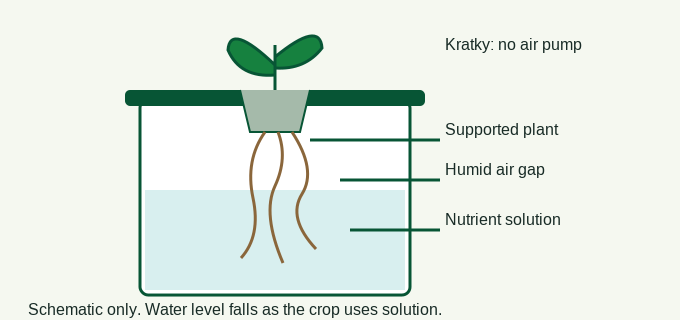
The Kratky method is named after Dr. Bernard Kratky, a researcher in Hawaii. A plant sits in a net pot on top of a container of nutrient solution. At the start, the roots just touch the water. As the plant grows and drinks, the water level drops, and a layer of air opens between the water and the net pot.
The upper roots breathe air while the lower roots keep drinking. That balance is the entire trick, and it is why you should not simply fill a jar to the brim and hope for the best.
A good first crop
Short-cycle leafy crops are ideal: lettuce, bok choy, and many herbs. Large, thirsty plants such as tomatoes can be grown in a very big container, but they are harder to get right because they use water quickly.
A general rule for lettuce is about two to four liters of solution per plant. A tiny jar can run dry before the plant is mature, especially in a warm room. Use an opaque or covered container so algae can’t grow, and a lid that supports the net pot without squeezing the stem.
Planting the seedling
Start a seed in a plug, and when it has true leaves and roots, place the plug in a net pot. Fill the container so the water touches the bottom of the net pot. Some growers keep it a little below, so roots have to reach for it.
Use a gentle nutrient strength for the first week or two. Young plants don’t need much, and a strong mix can burn tender roots.
Respect the air gap
This is the rule people most often break. Do not top up a Kratky container to the original level once the plant is established. The roots that grew in the air space are different from water roots, and flooding them can drown the plant.
If you need to add water, add a small amount so that the gap is still there, and keep the lower part of the root mass wet. Some people top up with plain water in tiny amounts. Others make the container big enough that no top-up is needed.
A simple first Kratky jar
Take a wide-mouth jar or a small bucket that blocks light, and cut or buy a lid with a hole for a net pot. Mix nutrients at a gentle strength and adjust the pH to roughly 5.5 to 6.5. Fill the jar until the water just touches the bottom of the net pot.
Place a seedling in the net pot, put the lid on, and put the jar somewhere bright. After a week, look underneath if you can. You should see white roots heading down and a small air gap forming. From then on, just watch the level and the plant.
Know the limits
Passive does not mean forget about it. Look at the plant every day or two. Check that the water level is dropping slowly, that the roots look white, and that nothing smells off. Warm weather speeds up water use and can shorten the crop.
Kratky is not ideal for long-lived crops, large fruiting plants, or very hot rooms. When you want to grow bigger or longer, move to an aerated system such as DWC. Between crops, empty the container, wash it well, and start with fresh solution.
Check a passive container without flooding the air roots
Passive growing is best understood as a water-and-air balance. Start with a compact crop from the lettuce growing guide rather than assuming a small jar can support a long-season fruiting plant.
| Observation | What it may mean | Useful next check |
|---|---|---|
| Solution has fallen and roots still reach it. | An air space is developing as the crop uses solution. | Check the plant and remaining volume against the expected crop duration. |
| Reservoir is nearly empty before harvest. | Starting volume may be insufficient for this crop or weather. | Plan a larger container next time; avoid flooding established air roots. |
| Algae appears on the surface. | Light is reaching the nutrient solution. | Inspect the lid, unused holes and the container covering. |
| Plant wilts while roots are wet. | The cause may involve oxygen, heat or root health, not a lack of water. | Inspect the root zone before automatically refilling to the lid. |
The original non-circulating approach plans enough solution for the crop. If your small home container needs intervention, do not suddenly submerge the whole air-adapted root zone. Mark the level on the outside and record how quickly it falls so the next container can be selected more accurately.
If you want a system with continuous aeration instead, compare it with an aerated DWC bucket.
Frequently asked questions
Does the Kratky method need electricity?
The root zone does not need power. If you grow indoors, you may still use a light on a timer.
Can I keep adding water to a Kratky jar?
Not up to the original level. You need to keep the air gap, so only add small amounts, or use a bigger container.
How long does a Kratky crop last?
Lettuce is usually ready in four to six weeks. Longer crops need larger containers or a different system.
What size jar do I need for Kratky?
For lettuce, aim for around two to four liters per plant. Herbs can do well in smaller containers, but they may need more water as they grow.
Why is my Kratky plant wilting?
The most common causes are running out of water, roots drowned by overfilling, heat, or algae and rot in the container. Check the water level and roots first.